Quantcast
Channel: SCN : All Content - BOPF Application Framework
Viewing all 309 articles
Browse latest View live

Drop Down Values filtering

$
0
0

Hi Everyone,


I have requirement like,


I created a table with drop downs and text view(incident group).


My requirement is I am populating  drop down values for each incident group which are maintained at SPRO level by using fill dropdowns method, but user expecting for particular (incident Group) row I have to delete one of the drop down value and display other drop down values nothing but user expecting only 4 values if 5 drop down values are there.


How can I achieve this.


Please help me.


Thanks in advance,

Pavan


Enabling Disabling Particular row Fields

$
0
0

Hi Everyone,


I created a Table with 4 columns checkbox text view and 2 input fields,


My requirement is, when user selected checkbox then the particular row input fields should become editable otherwise they should be in disable mode.


I created table by using fpm_list_uibb component.


How can I achieve this functionality.


Thanks in advance.


Thanks,

Pavan

Many-To-Many Relationships

$
0
0

Hi all,


We have a scenario where many-to-many relationships between business objects are required. We’d like to use the goodies of BOPF, since our requirements include, e.g., web services to read and update business objects (using OData).


Right now we are struggling to model such an n:m relationship. I know, that, on the one hand, business objects are hierarchically structured and therefore only support 1:n relationships. On the other hand, OData supports n:n relationships: Both …/Orders?$expand= Products and …/Products?$expand= Orders are possible if implemented correctly.


Is there a way to model an n:m relationship using business objects/BOPF, so that one OData service offering both associations can be generated automatically?


The only possibility we see right now includes:

  • Modeling both business objects separately
  • Modeling one “association class” business object to store the associations between those business objects
  • Create an OData service, having two entities representing exactly the business objects
  • Implement the getEntitySet of both entities: For expand use the “association class” business object to find all related business objects of the other entity

This looks like an unnecessary effort since all this could be generated, right?


In comparison, JPA has a @manyToMany-association, which automatically creates the association class and table. Is something similar possible using business objects/BOPF?


Thanks,

Svenja

Creating Delegate Node

$
0
0

I have demonstrated how to create a delegate node (Text Collection in our case), also have created a test report program to demonstrate usage of helper class and retrieve by associations to retrieve the text contents, going further we are consuming the Dependent BO in FPM.


Here we are embedding the Dependent Object /BOBF/TEXT_COLLECTION in our BO.

Right click Root node → Select Delegate node.
Provide node name, node prefix, under “Cross BO Relationship” select “Ref. Business Object” as /BOBF/TEXT_COLLECTION.

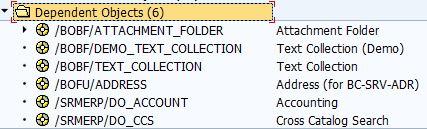
We can choose from the available Dependent Objects:

Node Prefix: The node prefix is used by BOPF at runtime in order to identify the Dependent Object which is called by the consumer.

When you create the Delegated Node as described above BOPF automatically creates the required association to the root node of the Dependent Object.

This is possible since the Text Collection Dependent Object supports a standard linkage to a hosting Business Object. The standard linkage is supported for each Dependent Object that fulfils the following requirement:

The embedded Dependent Object must have an alternative key on its root node that uses /BOBF/S_LIB_K_DELEGATION as DATA_TYPE and /BOBF/T_LIB_K_DELEGATION as DATA_TABLE_TYPE. The Alternative Key must be set to "Not-unique" to enable one-to-many usages of it.

We can see that in the Dependent BO for Text Collection.

Activate and regenerate the BOPF constant interface.


Adding Delegate Node instance using T-code BOBT:


Select the BO and provide query select all. Select the Root node and click edit button.

Navigate to ROOT_LONG_TEXT.

Click Create node instance, we may get the error.

Provide with the Test Schema ID as “DEFAULT” and “TEXT_EXISTS_IND” = “X” and click check. Save.

Now Opening the ROOT_LONG_TEXT we see:

Under “TEXT” create node instance and provide “TEXT_TYPE” and “”LANGUAGE_CODE”. I have added as:

Now Select the TEXT_CONTENT and create instance. Provide the Text “Demo Text”. Save. The records are now saved.


Testing the BO to get the Text available in TEXT_CONTENT:

The structure and table types used in our program are from ROOT and ITEM nodes:

Add the below code:

*Association to a Delegated node.
DATA: lt_mod TYPE /bobf/t_frw_modification,
      ls_mod TYPE /bobf/s_frw_modification,
      lo_message TYPE REF TO /bobf/if_frw_message,
      lo_chg TYPE REF TO /bobf/if_tra_change,
      lr_srv_mgr TYPE REF TO /bobf/if_tra_service_manager,
      lt_key TYPE /bobf/t_frw_key,
      lt_target_key TYPE /bobf/t_frw_key.

DATA: lv_text_node_key TYPE /bobf/conf_key,
      lv_content_node_key TYPE /bobf/conf_key,
      lv_text_assoc_key  TYPE /bobf/obm_assoc_key,
      lt_txc_text_key TYPE /bobf/t_frw_key,
      lv_content_assoc_key TYPE /bobf/obm_assoc_key,
      lt_txc_content TYPE /bobf/t_txc_con_k.

DATA: lt_root_data TYPE zmay1_t_root,
      ls_root_data TYPE zmay1_s_root,
      lt_item_data TYPE zmay1_t_item,
      ls_item_data TYPE zmay1_s_item.


*Get dependent object keys for retrieve by association calling helper method
*Helper method  = /scmtms/cl_common_helper=>get_do_keys_4_rba
*/bobf/if_txc_c = Interface of Dependent BO= /BOBF/TEXT_COLLECTION
*zif_may1_trq_c = Interface of our BO= ZMAY1_TRQ


*Flow:
*ZMAY1_TRQ ->ROOT -> ROOT_LONG_TEXT -> TEXT -> TEXT_CONTENT
*/BOBF/TEXT_COLLECTION -> ROOT -> TEXT -> TEXT_CONTENT

*Helper method to fetch node and keys
/scmtms/cl_common_helper=>get_do_keys_4_rba(
  EXPORTING
    iv_host_bo_key      =    zif_may1_trq_c=>sc_bo_key
    iv_host_do_node_key =    zif_may1_trq_c=>sc_node-root_long_text
    iv_do_node_key      =    /bobf/if_txc_c=>sc_node-text
    iv_do_assoc_key     =    /bobf/if_txc_c=>sc_association-root-text
  IMPORTING
    ev_node_key         =    lv_text_node_key
    ev_assoc_key        =    lv_text_assoc_key
).


/scmtms/cl_common_helper=>get_do_keys_4_rba(
  EXPORTING
    iv_host_bo_key      =    zif_may1_trq_c=>sc_bo_key
    iv_host_do_node_key =    zif_may1_trq_c=>sc_node-root_long_text
    iv_do_node_key      =    /bobf/if_txc_c=>sc_node-text_content
    iv_do_assoc_key     =    /bobf/if_txc_c=>sc_association-text-text_content
  IMPORTING
    ev_node_key         =    lv_content_node_key
    ev_assoc_key        =    lv_content_assoc_key ).


*Get Service Manager Instance

IF ( lr_srv_mgr IS NOT BOUND ).
  lr_srv_mgr = /bobf/cl_tra_serv_mgr_factory=>get_service_manager(
  zif_may1_trq_c=>sc_bo_key ).
ENDIF.

lr_srv_mgr->query(
  EXPORTING
    iv_query_key            =    zif_may1_trq_c=>sc_query-root-select_all
    iv_fill_data            =    abap_true     

  IMPORTING
    et_data                 =    lt_root_data    
    et_key                  =    lt_key 
).


*RETRIEVE_BY_ASSOCIATION - 1.  ROOT to ROOT_LONG_TEXT
lr_srv_mgr->retrieve_by_association(
  EXPORTING
    iv_node_key             =    zif_may1_trq_c=>sc_node-root
    it_key                  =    lt_key " Key Table
    iv_association          =    zif_may1_trq_c=>sc_association-root-root_long_text
  IMPORTING
    et_target_key           =    lt_target_key  "Retrieved key of root_long_text
).

*RETRIEVE_BY_ASSOCIATION - 2.  ROOT_LONG_TEXT to TEXT
lr_srv_mgr->retrieve_by_association(
  EXPORTING
    iv_node_key             =    zif_may1_trq_c=>sc_node-root_long_text
    it_key                  =    lt_target_key " ROOT_LONG_TEXT key
    iv_association          =    lv_text_assoc_key
  IMPORTING
    et_target_key           =    lt_txc_text_key ).

*RETRIEVE_BY_ASSOCIATION - 3.  TEXT to TEXT_CONTENT
lr_srv_mgr->retrieve_by_association(
  EXPORTING
    iv_node_key             =    lv_text_node_key
    it_key                  =    lt_txc_text_key
    iv_association          =    lv_content_assoc_key
    iv_fill_data            =    abap_true
  IMPORTING
    et_data                 =    lt_txc_content ).

BREAK-POINT.


The Output in Debugger with the text “Demo Text”:


Consuming the Dependent BO in FPM:


Pre-requisite: Please follow the link to get started with FPM BOPF Integration.

http://scn.sap.com/docs/DOC-45726

Enter T-code: FPM_WB to open the FPM Workbench and proceed with your application.

Create a Tabbed UIBB component.

Search for the Text Collection Config ID and add /BOFU/TEXT_COLLECTION_TAB.

Select the Wire Schema Tab and add a new wire with the below details.

Save and Test the application.


Testing the Delegate Node:


Entering the TRQ ID and click continue.

On the Next screen we see the Text Collection delegate node with the text content.

Thank you..

FPM BOPF form UIBB fields disabled

$
0
0

Hi All,


I have created a custom BOPF application for which i have used FPM as UI.I have done the integration between FPM and BOPF but still when i execute the application its showing as disabled mode. How to make it enable?


Im using form GUIBB which is linked to a BO using FBI.


Note: My requirement is like a registration form.


BOPF.jpg


Thanks in advance.


Regards,

Bob.

BOPF Modify a node with a node type "Business Object Representation Node"

$
0
0

Hello,


the standard PDF "Root Cause Investigation" (EHHSS_INC_AIF_INV_ROOTCAUSE) has a section with "Planned action to Prevent Future Incident' and when this PDF goes to SAP...It modifies the incident. SAP did not code the section "Planned action..." which refer to the tab 'Task' in the incident...we opened an OSS message but SAP said it is delivered like that....


The PDF use the BOPF with business object EHHSS_INCIDENT and there is a "Business Object Representation Node" for EHHSS_INCIDENT_ACTION. I need to add an action(BO EHHSS_INCIDENT_ACTION) to the incident(BO EHHSS_INCIDENT) in the method "STORE_DATA" of the inbound persister CL_EHHSS_INC_AIF_INV_ROOTC_INB.


node.JPG

When I executed this code...I get a short dump and I think the problem is the association but I am new to BOPF...Can someone help me to get through this please?


   FIELD-SYMBOLS: <ls_mod> LIKE LINE OF lt_mod.

   DATA: lr_s_root TYPE REF TO ehfnds_act_root,

            mo_svc_mngr TYPE REF TO /bobf/if_tra_service_manager.

             lo_change      TYPE REF TO /bobf/if_tra_change.         
             lo_message   TYPE REF TO /bobf/if_frw_message.

      "Obtain a reference to the BOPF service manager:
    mo_svc_mngr =
      /bobf/cl_tra_serv_mgr_factory=>get_service_manager(
        if_ehhss_inc_c=>sc_bo_key ).

    CREATE DATA lr_s_root.

    lr_s_root->key = /bobf/cl_frw_factory=>get_new_key( ).
    lr_s_root->root_key_ref = ls_inc_root-db_key.                     "Key of the current incident
    lr_s_root->node_key_ref = /bobf/cl_frw_factory=>get_new_key( ).
    lr_s_root->bo_key_ref = if_ehhss_inc_c=>sc_bo_key.         "BO Incident key
    lr_s_root->category = '001'. "  Action
    lr_s_root->priority = '5'.   "  Normal
    lr_s_root->purpose = 'INC_ACTION'"  Incident Action
    lr_s_root->ehsm_component = 'HSS'.
    lr_s_root->variant = 'STANDARD'.

    lr_s_root->status = if_ehfnd_bo_status_c=>gc_transaction-new"'01'. "  New
    lr_s_root->title  = 'test'.
    lr_s_root->resp_id = 'USER123'.
    lr_s_root->implem_id = 'USER123'.
    lr_s_root->appr_id = 'USER123'.
    lr_s_root->due_timestamp = '20140418'.

    GET TIME STAMP FIELD lv_cur_timestmp.        
    lr_s_root->datetime_cr = lv_cur_timestmp.   
    lr_s_root->datetime_ch = lv_cur_timestmp.   


    APPEND INITIAL LINE TO lt_mod ASSIGNING <ls_mod>.
    <ls_mod>-node        = if_ehhss_iac_c=>sc_node-root.          "Incident action
    <ls_mod>-change_mode = /bobf/if_frw_c=>sc_modify_create.
    <ls_mod>-source_node = if_ehhss_inc_c=>sc_node-root.      "Incident
    <ls_mod>-association = if_ehhss_inc_c=>sc_association-root-ehhss_incident_action.
    <ls_mod>-source_key  = ls_inc_root-db_key.                       "Incident
    <ls_mod>-key         = lr_s_root->key.
    <ls_mod>-data        = lr_s_root.
   
    CALL METHOD mo_svc_mngr->modify
      EXPORTING
        it_modification = lt_mod
      IMPORTING
        eo_change       = lo_change
        eo_message      = lo_message.


Thank you!


Marie-Josée

getting root data in item node

$
0
0

Hi all,

          i am created 2 nodes . They are root node and item as subnode.

Initially i entered root data then i went to item data ,here i want to read the root data .

How i can read the root data in item node.  ???


ex: root node and item node i am having emp_id field.. here once i enter the root data emp id ,then i go to item node here emp_id filled by default with  emp id entered in root node.


through determination i am trying to read the root data. in item level..


can anyone give me the code to read the root data in item node..?

Several Problems with BO Retrieve Expression of BRFplus

$
0
0

The BO Retrieve is an expression type of BRFplus that makes it possible to access data of a BOPF object within a BRFplus rule system. It is a part of BOPF reuse tools so this is the right place for posting my question.


I would like to access the eMail address of an /BOFU/BUSINESSPARTNER object. As node I'm choosing ADRESSPARTNER.ROOT and EMAIL as association.


The first problem comes when I generate the result data object and choosing only the URI values since I get a dump. When you analyse the the source code the reason is very simple: the component URI of structure /BOFU/S_ADDR_EMAILK is a built in data type but has no DDIC representation which causes the problem.


But the second problem is far more severe: you can activate the expression when you choose the whole structure /BOFU/S_ADDR_EMAILK as result structure resp. the table within this structure type. But after doing so I’m not able to read the information using BRFplus simulation even if I see the values in for a certain business partner in transaction BOBT. I suspect the BO retrieval doesn’t work with associations in SAP_BS_FND 747 SP 5. 


Am I right? Do you have the same problems?`


Best Regards,

Tobias


How to Save attachments in BOPF

$
0
0

Hi,


We have a requirement to attach a file and saving the same in database. The flow is as below.

UI5-->Odata-->BOPF.  I have gone through the document (http://scn.sap.com/docs/DOC-46279) and created delegation node and added the Attachment folder BO. How to connect it to Odata and what else has to be done in BO. Please could any one help me.


Thanks and Regards,

Pushpa

Any good material/link for BOPF?

$
0
0

Dear Experts,


I am looking for detailed documentaion on BOPF which covers every piece of information.


I have Basic & Extetnded BOPF materials and I have gone through James Wood blog as well.


But I need in depth knowledgeo on BOPF,Kindly help me.


Thanks in advance.


Regards,

Saurabh

Application Log BO in BOPF

$
0
0

I am new to BOPF and have learnt the basic of BOPF (create custom Business Object, query/modify records, alt.key, etc). 


The Application Log BO is mentioned in the following blogs.  However, I am not able find enough material for me to integrate my BOPF with Application Log.


Below are topics that I have looked into, but no conclusion yet.

  • I am aware of the existing of
    • /BOFU/BASIS_APPLICATION_LOG
    • /BOFU/CL_LIB_C_APPLICATION_LOG
    • /BOFU/CL_A_BAL_ACTION
  • I also wonder if I have to learn about Output Management, but this isn't clear to me.
  • I have done PPF before when doing custom development in Solution Manager, but I do not see example of how to link that to Application Log.


I believe /BOFU/BASIS_APPLICATION_LOG is the correct object to use along with its actions from /BOFU/CL_A_BAL_ACTION.  However, I am not able to get it working.


I am hoping there is someone out there can give a some reference as to how to implement application log within BOPF.

BOPF SCN Sitemap

$
0
0

The BOPF SCN space contains a lot of of discussions, useful blog posts and tutorials about the BOPF. This BOPF SCN Sitemap provides an overview so that you quickly get find what you're searching or just for browsing the information. If you miss a ressouce, please just sent my a message and I will keep that page up to date in the future.


1. BOPF Tutorials
If you have not created your first BOPF Business Object, it is time to create one. BOPF Business Objects are created by the SAPGUI transaction "BOBX" or the new Eclipse design time tool. In addition, we provide the "BOB" transaction for easily extend existing Objects or create new customer objects.


2. BOPF Overview Documents

Those documents provide you a high level overview about BOPF and its features.

3. BOPF Topics

3. Other Topics
Here is information about some specific issues, that might help you.

4. BOPF Training

You need more Information? Ask the community or take part at our BOPF trainings:

Updating an object from a BADI

$
0
0

Hi all,


The method SAVE of transaction manager - /bobf/if_tra_transaction_mgr->save( ) - calls a commit work to save the new values. I'm trying to use it in a BADI where commit work is not allowed. How do I save the values from this BADI? Is there another way to save other than using transaction manager?


Regards,

Custodio

How to include administrative data to a BOPF node

$
0
0
Developing a data model for your application, you normally want to track changes. So you add attributes like created_by, changed_by and so on at least for the header data. Sometimes the business requires also to track changes on item level. BOPF supports this standard requirement by a library function. This tutorial shows you how to use it in your BOPF BO.
The tutorial starts with the business object SALES_QUOTE created in the ‘Getting Started with Business Object Processing Framework’. This Business Object follows the semantics of the sales quote based on the NetWeaver Enterprise Procurement Model (EPM). You can use the BOB or BOBX editor. The tuturial uses BOB.

bo_structure.png
In the first step we include the structure /BOBF/S_LIB_ADMIN_DATA in the persistent structure of the root node.

In the second step we create the determination on the root node.

Last but not least we test the changes in the BO test tool BOBT.


Enhance the structure of the root node


In this step we will enhance data structure of the root node and add the attributes for administrative data. Launch the Business Object Builder (BOB). Open the business object ZD_SALES_QUOTE and navigate to the root node.


rootnode.PNG


Double click the persistent structure and navigate to the data dictionary. Insert an include with the data type /BOBF/S_LIB_ADMIN_DATA and the group name ADMIN_DATA. This data structure contains the attributes CREA_DATE_TIME and LCHG_DATE_TIME - both typed with the data element TIMESTAMPL for UTC timestamp - and the attributes CREA_UNAME and LCHG_UNAME - both typed with the data element UNAME.


ddic.PNG


Save and activate the DDIC change. Then go back to the BO editor.


Create a determination


In the BO editor, start the determination creation wizard on the root node. Enter the determination name DET_ADM_DATA and a description.


w_name.PNG

Continue to the next step where you enter the name of the implementing class. Use the BOPF library class /BOBF/CL_LIB_D_ADMIN_DATA_TSM which cares for maintaining the adminstrative attributes.


w_class.PNG

Continue to the next step to determine the Determination Pattern. Determinations can be executed at different phases of the transaction. Administrative data must only be updated before the user saves the BO instance. So we select the pattern Derive dependent data before saving.


w_det_type.PNG

Continue to the next step to define the trigger nodes. As we only defined the administrative data on the root node, we want it to be updated at any time something changes in the BO instance, be it on root or item level. So we have to select all nodes as trigger nodes. The administrative data must be updated even when an item is deleted, not only when a root or item node is created or updated. We want to track all changes.


w_trigger.PNG

Continue and complete the wizard. The administrative data is now updated at any change on the BO instance. You can verify this with the BO test tool (BOBT).


Test the changes


To test the changes launch the transaction BOBT. Open the BO ZD_SALES_QUOTE and add a new instance. You can see the new attributes to track the BO changes. If you save the data the attributes are determined by the framework. Play around with item instances. You will see that they also influence the update of these attributes.


test.PNG

Summary


With a few model changes and the use of a BOPF library class, you can add attributes for tracking business object changes on each node level without having to code it by your own. You can test the new feature without any test code in the BO test tool.

Slave Transaction Manager

$
0
0

In some cases it is required to integrate logic implemented by the help of BOPF into other applications. Using the service manager of BOPF, all application logic can be easily consumed by other applications. But what is about the saving a transaction?


In a standalone BOPF application, the consumer ends the current transaction by the help of the standalone transaction manager. It provides the option to make the current transaction undone (called "cleanup") or to save all changes since the last save to persistency (called "save").


Example:

DATA(lo_transaction_manager) = /bobf/cl_tra_trans_mgr_factory=>get_transaction_manager( ).
lo_transaction_manager->save( ).


While executing the save, BOPF registers by default an update task to write the modifications done in the current transaction from buffer into the database tables. Finally, a COMMIT WORK is executed. However, there are situation that do not allow BOPF to raise a COMMIT WORK. For instance, if the BOPF application is integrated into an existing application or foreign application framework.In that case, a slave transaction manager can be used by the foreign application to prepare the BOPF objects of the current transaction for the saving and afterwards to execute the COMMIT WORK. The foreign application is called master transaction manager as it invokes the COMMIT WORK and ROLLBACK WORK - and not the BOPF:

slave.jpg

The master transaction manager (called "Legacy Application" in the picture) has to call Finalize/CheckBeforeSave/... on the slave transaction manager before triggering the COMMIT WORK. This triggers for instance the execution of the finalize determination of the participating BOPF BOs.


Example:

DATA(lo_slave_transaction_manager) = /bobf/cl_tra_trans_mgr_factory=>get_slave_transaction_manager( ).

lo_slave_transaction_manager->finalize( ... ).


After the COMMIT WORK, the BOPF BOs shall be invoked via the slave transaction manager's AfterSuccessfulSave core service. This is in priniciple only necessary if the the participating BOs have AfterCommit determinations configured and it is intended to continue with the next transaction in the same session.

Hint: You can check the implementation of method  "/BOBF/CL_TRA_TRANSACTION_MGR->/BOBF/IF_TRA_TRANSACTION_MGR~SAVE()" to learn about the correct order and error handling of the Finalize/CheckBeforeSave/AdjustNumbers call sequence and the error handling in between.


BOPF authority: failed to assign authorization field bo_service

$
0
0

Current project implement BOPF authority checks. when I assign authorization filed bo_service to authorization object the authorization filed could not be selected or find. however I can find it by running tcode su20. 


I already open the bo node authorization check and the root authorization check,  the root authorization check is working but item level check is failed.

3.gif


could any expert help me or give me a hint  ?   thanks a lot.

Data not shown unless saved and refreshed

$
0
0

Hi,

     I have enhanced the BOPF and added a new node. I have configured the feeder class and enhanced UI to display a custom tab.


The issue I am facing is that when I click on a button, I am generating values for this node.  I have used change_mode = 'C' , created new GUI id and passed parent_guid.


After calling modification method, the screen doesnt display the new values. The feeder class doesnt get the updated value.


But after saving the application, if I open the same document I am able to view the data on the screen.


May I know what is going wrong here?


Regards,

Niyaz

FBI Transaction Handler Class

$
0
0

Hi experts,


I've done some basic implementations with FPM BOPF Integration and was wondering how the standard BO CRUD operations must be implemented. So far, I based myself upon the very good introductory document by Matan Taranto, but the guide neither SAP help explain how to handle CRUD operations.
Via, for example, a list GUIBB I can add a toolbar button and link it to one of the node's CRUD actions (SAP help, "Configuring a BO Action"). Unfortunatelly this button is only enabled for custom actions I created for that BO's node, not for its standard CRUD actions. The FPM application warns me that the Transaction Handler Class (Wire schema) is missing and I suspect this is cause of the problem. Do we have to create this transaction handler class ourselves? How do we link it to the BO's service / transaction manager?


Many thanks in advance!


Kind regards,

Bjorn

Is it very necessary to map BOPF Authorization field for BOPF Authorization

$
0
0

1.
Is it very necessary to map authorization filed? 

I did not map authorization field for the BO which implement BOPF authorization check.

It is successfully activated.  But got error message when doing check on the BO. 

If there is error why the BO activation  is success ? 

May I left blank under authorization field mapping?


2.
I define one authorization object “/XX/number” and assign 3 authorization fields “actvt; bo_serivce; /XX/number” . 

if adding  /XX/number  to authorization field mapping. 

Does It  mean I change other files would not trigger the authorization checking ? 

I want to  trigger the authorization check when user change any fields on root ,

how should I do?

Difference between Delegated Node and BO Representation Node

$
0
0

Hello Fellow BOPFers,


Firstly I would like to thank you all for the helpful blogs and posts in this space; it really helped a lot.


I have recently started to get my hands dirty on BOPF. I have created a demo BO with a delegated node TEXT_COLLECTION and BO representation node CHANGE_DOCUMENT. TEXT_COLLECTION is populated by the consumer API whereas CHANGE_DOCUMENT is populated by the framework. I was wondering if there was any other difference between these 2 node types other than the manner in which they are populated.


Thanks

Kiran Raorane

Viewing all 309 articles
Browse latest View live


<script src="https://jsc.adskeeper.com/r/s/rssing.com.1596347.js" async> </script>